 SKY
Sky catalog › Galaxies
Pinwheel Galaxy
M101, NGC 5457 · A galaxy in Ursa Major
What is it?
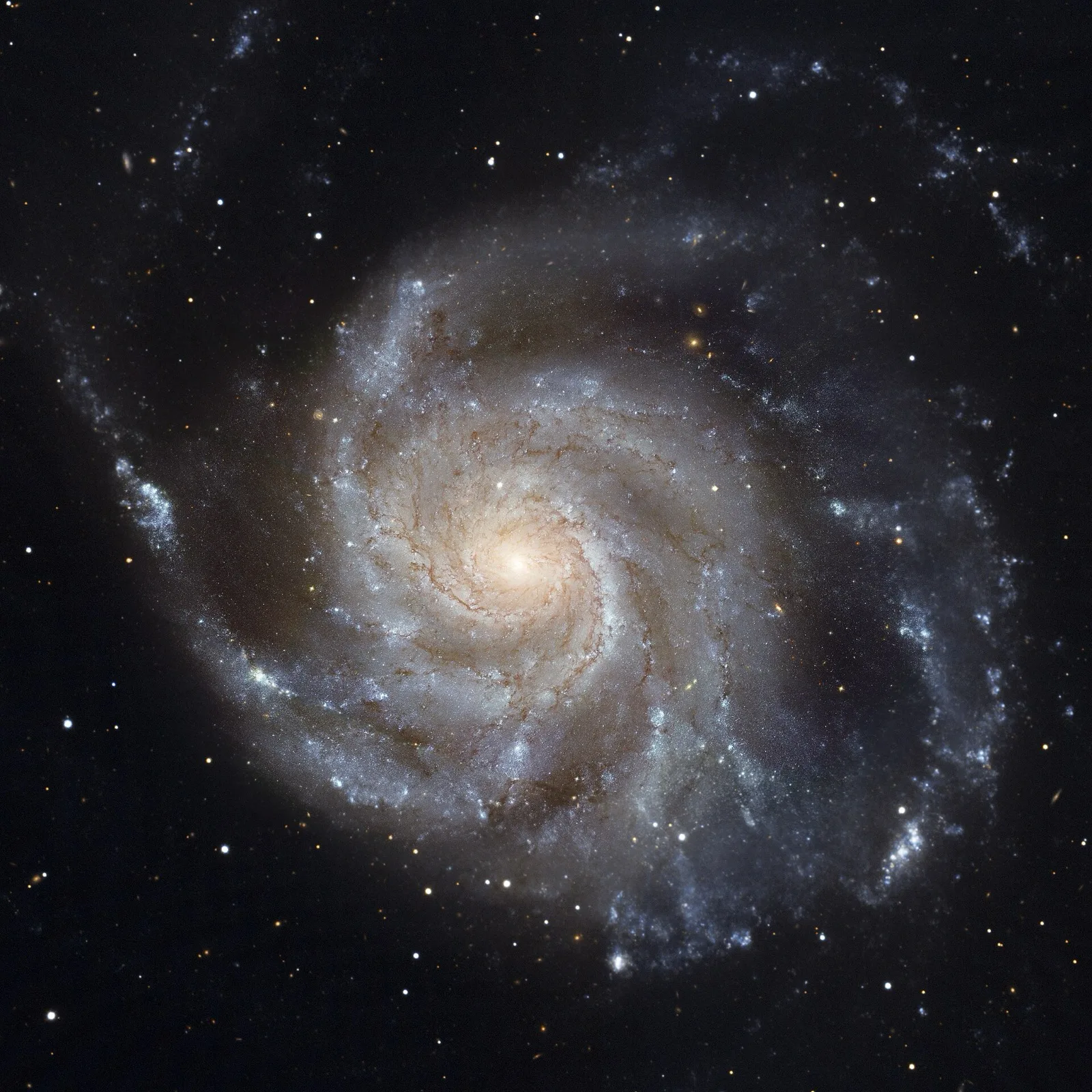
Pinwheel Galaxy is a galaxy. A whole island of millions to trillions of stars, far outside our Milky Way.
Why the Pinwheel Galaxy is interesting
What you see: The swirls are spiral arms full of stars, and the bright knots along them are glowing clouds where stars are born. A 1990 atlas counted 1,264 of these clouds. astronomy.com
How it formed: At least six companion galaxies, including NGC 5474 and NGC 5204, pull on the Pinwheel with their gravity, and that tugging makes its arms lopsided. astronomy.com
To scale: The Pinwheel is about 170,000 light-years across, nearly twice as wide as our Milky Way, so light needs about 170,000 years to cross it. en.wikipedia.org
Three things to know
- The Pinwheel is about 170,000 light-years across, nearly twice as wide as our Milky Way.
- It holds at least one trillion stars.
- Hubble built one of its biggest galaxy pictures of the Pinwheel from 51 separate exposures.
12 more fun facts
- When supernova SN 2011fe was found in the Pinwheel on August 24, 2011, it was about a million times too dim to see with the naked eye. Within weeks it reached small-telescope brightness. en.wikipedia.org
- In May 2023 Koichi Itagaki discovered supernova SN 2023ixf in the Pinwheel. en.wikipedia.org
- Supernovae have been spotted in the Pinwheel in 1909, 1951, 1970, 2011 and 2023. en.wikipedia.org
- A 1990 atlas cataloged 1,264 glowing star-forming clouds in the Pinwheel. astronomy.com
- Three of the Pinwheel's star-forming clouds, NGC 5461, NGC 5462 and NGC 5471, are bright enough to have their own NGC catalog numbers. astronomy.com
- At least six companion galaxies, including NGC 5474 and NGC 5204, pull on the Pinwheel and make its arms lopsided. astronomy.com
- In 2001 NASA's Chandra X-ray Observatory identified an ultraluminous X-ray source in the Pinwheel, now called M101 ULX-1. en.wikipedia.org
- About 150 globular star clusters orbit the Pinwheel, a number similar to the Milky Way's. en.wikipedia.org
- We see the Pinwheel face-on, which spreads its light thin and makes it look faint even though its total brightness is fairly high. astronomy.com
- The Pinwheel's disk weighs on the order of 100 billion Suns, while its central bulge is only about 3 billion Suns. en.wikipedia.org
- Seen from Earth, the Pinwheel's spiral turns counterclockwise. en.wikipedia.org
- A Hubble and Webb view of the Pinwheel's center helped astronomers study tiny carbon-rich dust grains called polycyclic aromatic hydrocarbons. science.nasa.gov
In the game these unlock one by one as you keep photographing the Pinwheel Galaxy.
At a glance
- Type
- Galaxy
- Catalog
- M101, NGC 5457
- Constellation
- Ursa Major
- Distance
- about 21 to 25 million light-years (estimates differ)
- Brightness
- magnitude 7.9
- Size in our sky
- 28.8 x 26.9 arcminutes
- Discovered
- Pierre Méchain, 1781
- Position (J2000)
- RA 14h 03m, Dec +54.4°
Looking back in time
The light in this photo left the Pinwheel Galaxy 21 million to 25 million years ago, when there were no humans or great apes, and the dinosaurs had already been gone for more than 20 million years.
How to see it yourself
Needs a telescope and a dark sky. Photos show far more than the eye can see.
Finding it: Go to the end of the Big Dipper's handle. The Pinwheel sits at the third corner of a nearly equal-sided triangle made with the stars Mizar and Alkaid.
When to look: Best on late spring and early summer evenings for mid-northern observers; NASA names June as the best month. It needs a dark, clear sky.
What you will see: Not visible to the naked eye. Large binoculars under dark skies can show it as a faint glow. In a small telescope the core is fairly easy, but the dim spiral arms need excellent, dark skies, and larger telescopes show its lopsided arms.
Easy to confuse with:
- Whirlpool Galaxy (M51): M51 lies about 3.5 degrees southwest of Alkaid and shows a smaller, brighter core with a companion beside it, while M101 is a large, faint, round glow.
- Triangulum Galaxy (M33): M33 is also sometimes called the Pinwheel, but it is in Triangulum in the autumn sky, far from the Big Dipper.
Best months: April is when it is highest around midnight. About two months later it is highest in the early evening, at around 8 to 9 PM.
Where on Earth: easy from the Northern Hemisphere. South of latitude 26°S it never climbs more than 10° above the horizon. From 36°N and farther north it never sets.
How it is photographed: long exposures through filters, many hours in total, which is why the game sends it to a big observatory mirror. then the frames are stacked, stretched and combined into color.
Name and story
The name: Pierre Méchain, Charles Messier's colleague, discovered it on March 27, 1781, and Messier verified it for his catalog as M101; it is also NGC 5457. Its nickname comes from the way its arms spread out like a pinwheel seen face-on.
People and history: In the second half of the 1800s Lord Rosse studied the Pinwheel with his 72-inch reflector in Ireland and was the first to describe its spiral structure in detail.
Record: SN 2011fe in the Pinwheel was the youngest Type Ia supernova ever discovered. It peaked around September 13, 2011 at magnitude 9.9, bright enough for small telescopes.
Explored by: Hubble's Pinwheel mosaic combines 51 exposures taken over nearly ten years into an image 16,000 by 12,000 pixels, with ground-based pictures filling the gaps. NASA calls it one of the largest images Hubble has made of a spiral galaxy.
Test yourself
After every photo of the Pinwheel Galaxy the game asks one of these. A right answer earns sky points for your observatory.
Why does the Pinwheel look faint in a backyard telescope?
- It is over a billion light-years away
- A thick dust cloud hides most of it
- Its light is spread thin across its face (the answer)
We see it face-on, so its fairly high total brightness is spread over a wide patch of sky, and each part of it looks dim. astronomy.com
What did Koichi Itagaki find in the Pinwheel in May 2023?
- A planet like Earth
- A comet heading for the Sun
- A supernova, an exploding star (the answer)
SN 2023ixf joined a long list: supernovae have been seen in the Pinwheel in 1909, 1951, 1970, 2011 and 2023, so watchers keep checking it. en.wikipedia.org
Point a telescope at the Pinwheel Galaxy in the game: capture it in real time, then develop the frames like an astrophotographer.
Point a telescope at the Pinwheel GalaxyLearn more
- Stacking: how many dim frames make one clear picture
Why astrophotographers take dozens of exposures of the same object and average them, and why the noise falls with the square root of the number of frames.
More galaxies
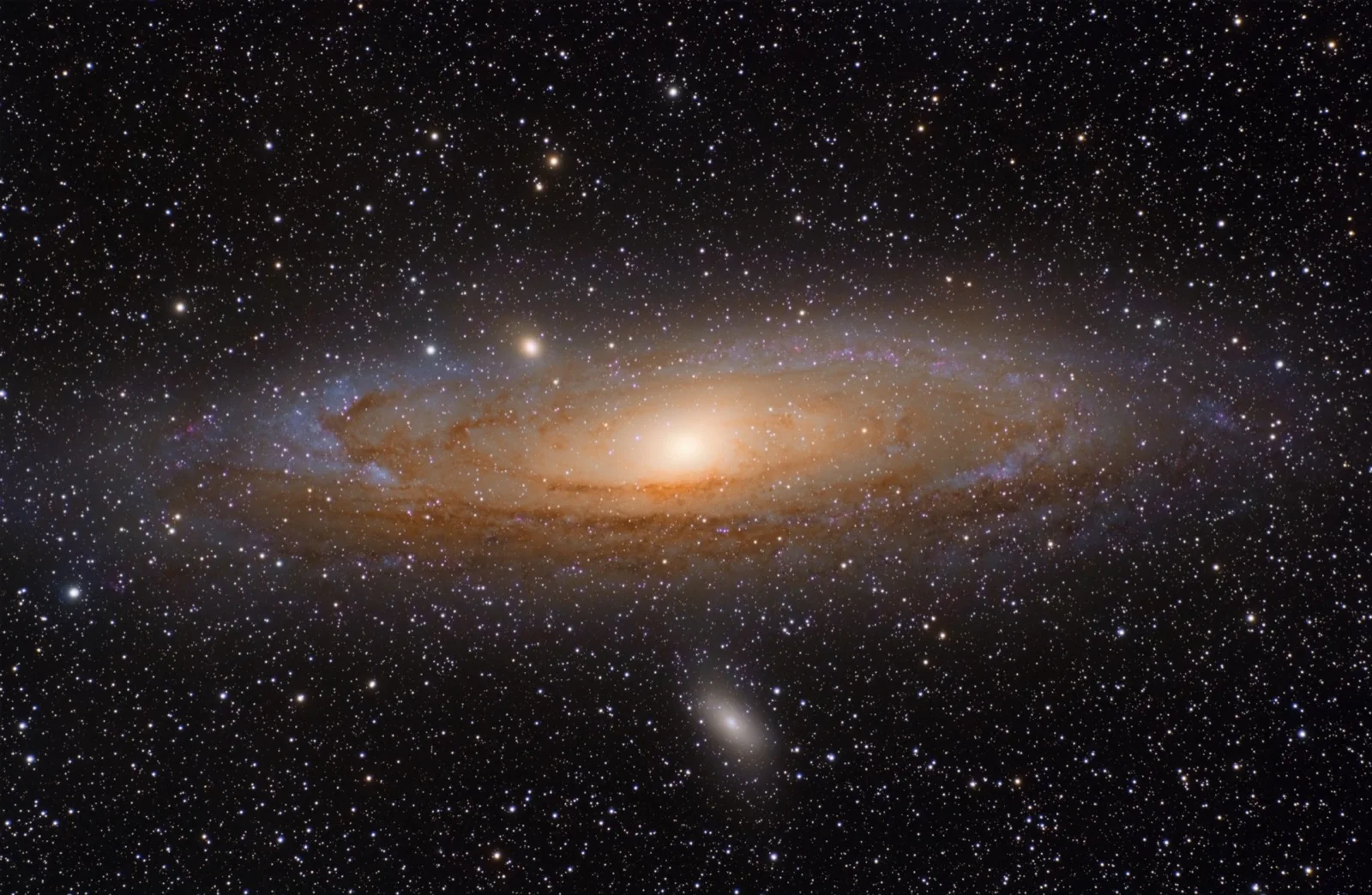 Andromeda GalaxyM31 · galaxy
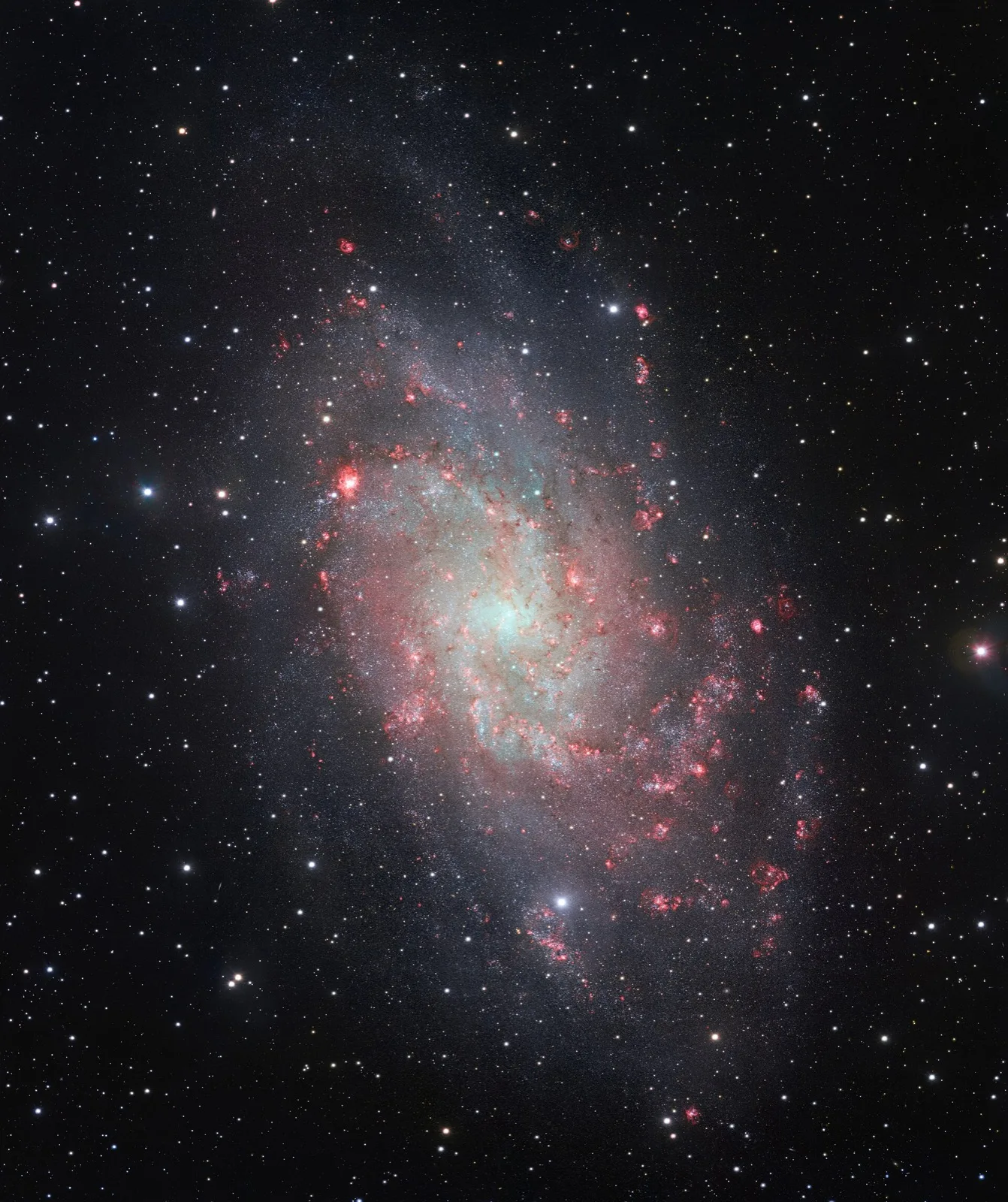 Triangulum GalaxyM33 · galaxy
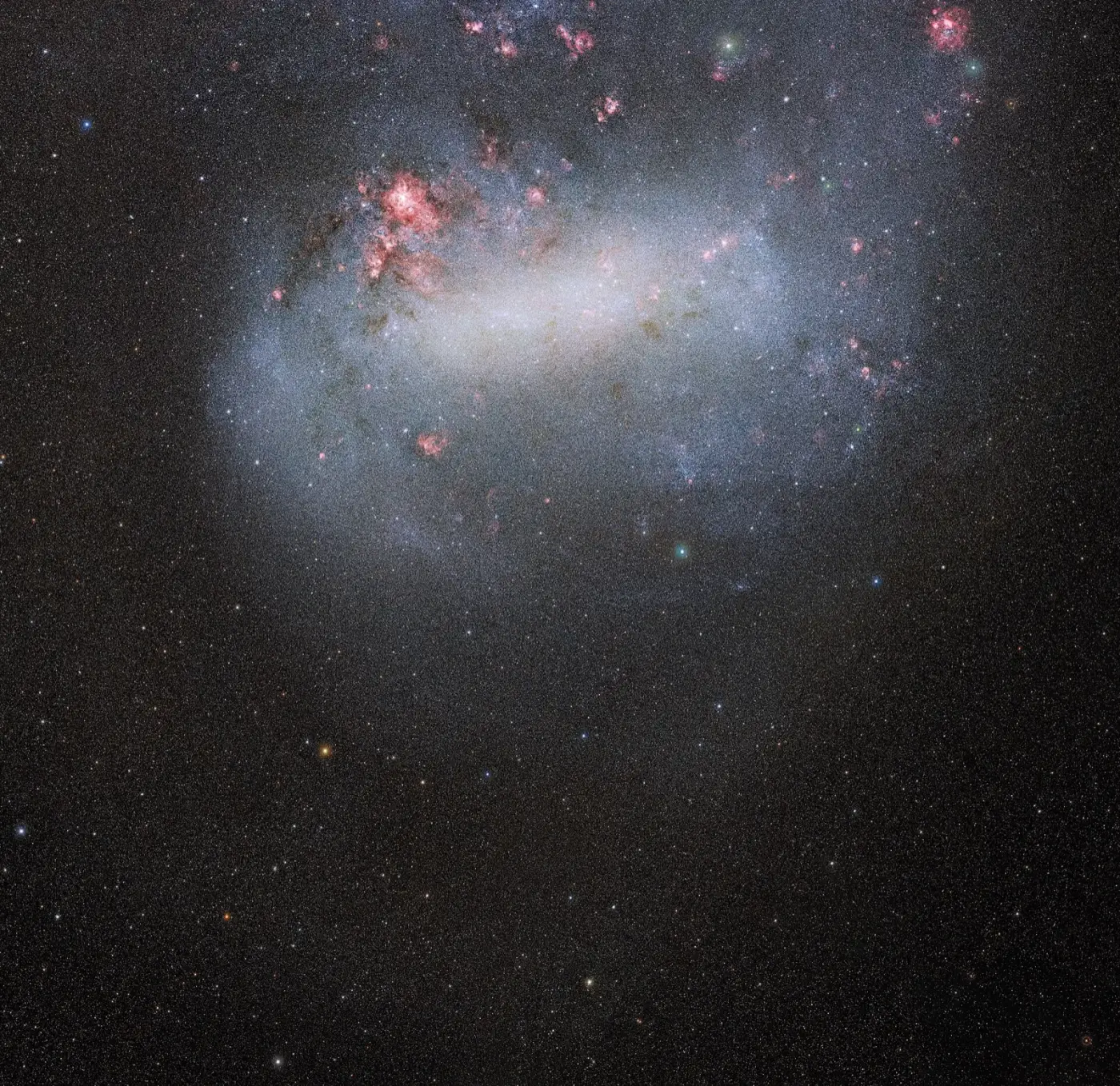 Large Magellanic CloudLMC · galaxy
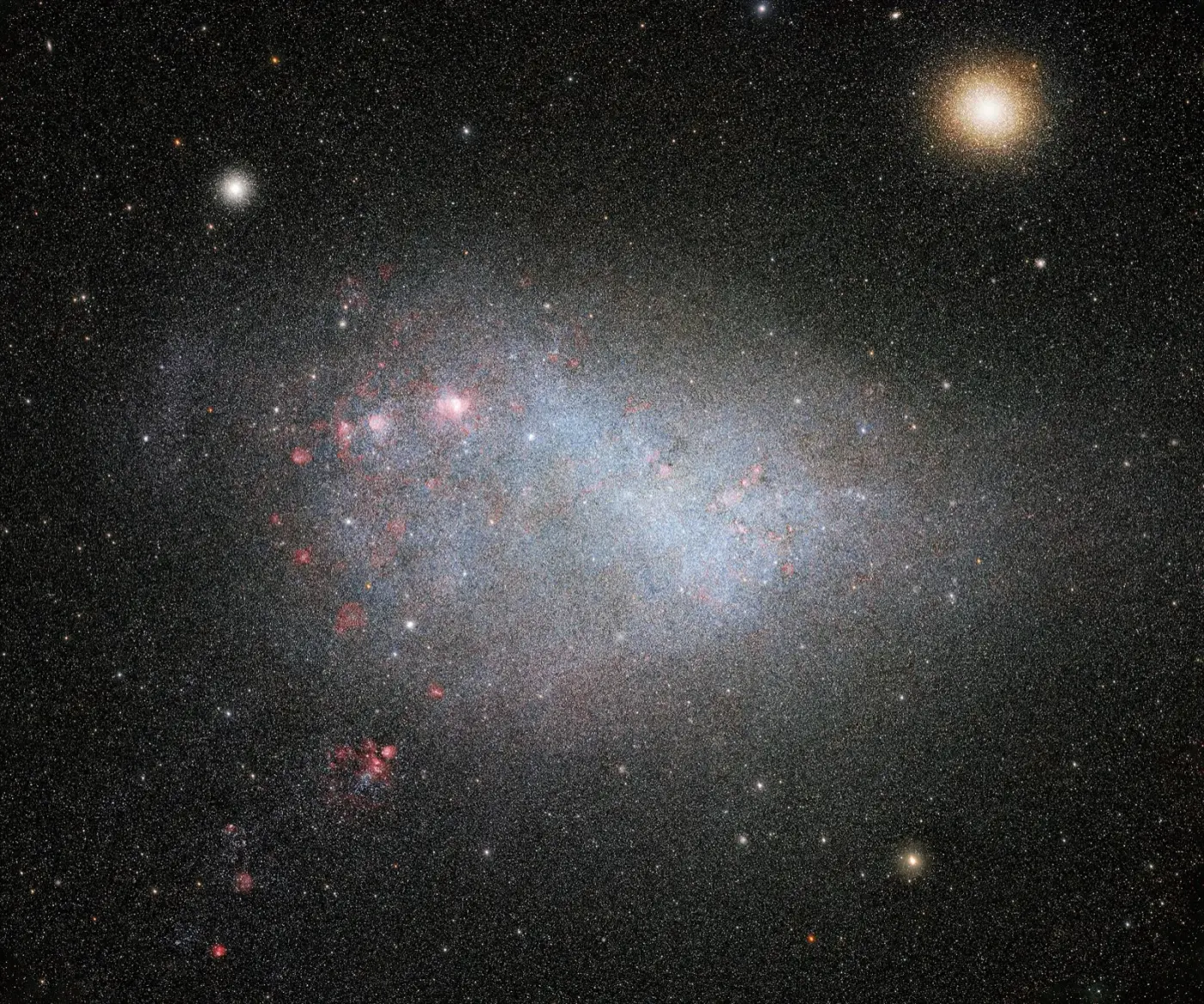 Small Magellanic CloudSMC · galaxy
Sources
- en.wikipedia.org
- science.nasa.gov
- en.wikipedia.org
- astronomy.com
- Positions: astronomy-engine (Don Cross).